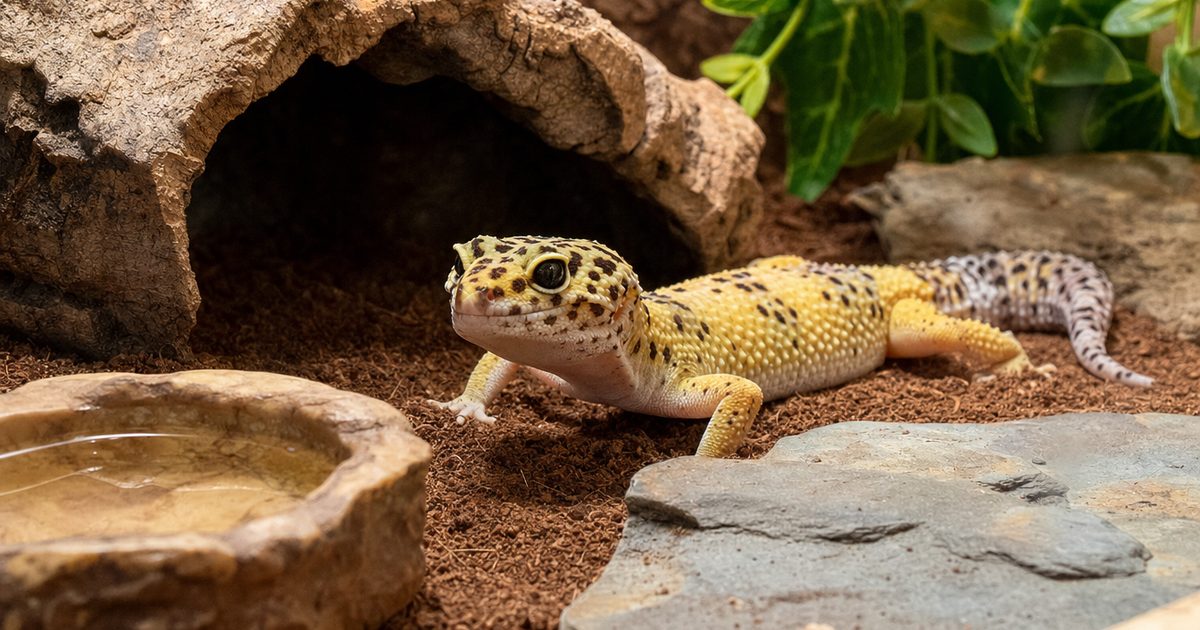
My first leopard gecko nearly didn’t make it, and the setup that almost cost it was the one the starter kit told me to build. I tell this story a lot — at reptile meet-ups, to anyone who messages me about a new gecko — because it’s the reason Heat & Hide exists. It wasn’t a tragedy. It was a close call. But it was close enough that I never wanted another beginner to learn it the way I did, at the animal’s expense.
What the kit told me to do
Twelve-plus years ago, I walked out of a shop with a small tank, a clip-on lamp, and a starter kit, and I set it up exactly the way the box suggested. A stick-on dial thermometer on the glass. An under-tank heat mat plugged straight into the wall, no thermostat. And a coil — a compact, screw-in UVB bulb — dropped into the lamp because the packaging said “reptile light.”
It looked right. The little dial read a temperature that seemed fine. The mat was warm to the touch. The light came on. I genuinely thought I’d done my homework. I’d bought everything the kit said I needed, and I’d assembled it the way the instructions showed.
The problem was that almost none of it was doing what I thought it was doing.
Why “looks right” wasn’t right
Here’s the thing nobody had explained to me. A stick-on dial thermometer reads the glass, not the floor of the enclosure where the gecko actually sits. So my reassuring number was telling me about a pane of glass an inch off the substrate, not the surface my gecko was lying on. The dial said one thing; the floor was another.
The heat mat, running with no thermostat, was the bigger issue. A mat plugged straight into the wall just runs — full output, all the time, with nothing regulating it. The warm end climbed higher than I realised, and the cool end of that little tank had nowhere genuinely cool to retreat to. So I didn’t have a gradient. I had one end that ran too warm and another end that wasn’t much different. A reptile thermoregulates by moving between temperatures, and I’d given mine nowhere useful to move to.
The coil bulb was the third miss. I’ll go deeper on coil-versus-tube UVB another time, but the short version is that a compact coil dropped in “because the box said reptile light” is not the same as the right UVB strength mounted at the right distance.
What I actually saw
Within a few weeks my gecko changed. It stopped coming out. It stayed jammed in one hide, didn’t want food, and looked pale and flat — not the alert little animal I’d brought home. I knew something was wrong, but I didn’t know what, and that’s the worst feeling as a new keeper: you can see your animal is off, and you can’t read why.
The reptile meet-up that turned it around
What saved me was another keeper at a local meet-up. I described what was happening and instead of making me feel stupid, they asked one question: “What’s your floor temperature reading — on a probe, on the substrate?” I didn’t have an answer, because I’d been reading a dial on the glass.
They put a digital probe on the floor of the warm end and showed me the actual number. Then they walked me through the non-negotiables, plainly: a real temperature gradient on a thermostat, the correct UVB at the correct distance, and proper hides — warm, cool, and humid. Husbandry first, décor later.
What I changed — and what changed back
I went home and rebuilt it.
- I put the heat source on a thermostat so the warm end was held to a target instead of running wild.
- I swapped the stick-on dial for a digital probe thermometer, with the probe on the substrate where the animal sits — so I was reading the floor, not the glass.
- I sorted the UVB properly — the right strength at the right mounting distance, not a coil dropped in by guesswork.
- I gave it a proper set of hides, including a humid hide, on both the warm and cool ends so it could thermoregulate and still feel secure.
It took a little while, but the gecko came back. It started coming out again, started feeding again, and turned back into the alert little animal I’d brought home. That’s the whole story: a close call, fixed by getting the environment right.
If you’re setting up your first one
If you take one thing from this, let it be that the environment comes before everything else — and “it looks right” is not the same as “the numbers are right.” A stick-on dial thermometer ruins more first setups than a cheap bulb does, because it tells you a comforting lie about the glass while the floor your animal lies on goes unmeasured.
I wrote up the whole thing properly — in the order I’d actually do it now — in the guide on how to set up a reptile vivarium. Build the heat gradient on a thermostat, read the floor with a probe, get the UVB and the hides right, and verify the parameters for your exact species before you bring the animal home.
This is general husbandry information from my own keeping experience, not veterinary advice. Temperatures, UVB and enclosure figures vary by species and morph — always verify the requirements for your animal, and if it’s unwell, off its food, or behaving abnormally, see a qualified reptile vet.