How to Set Up Your First Reptile Vivarium
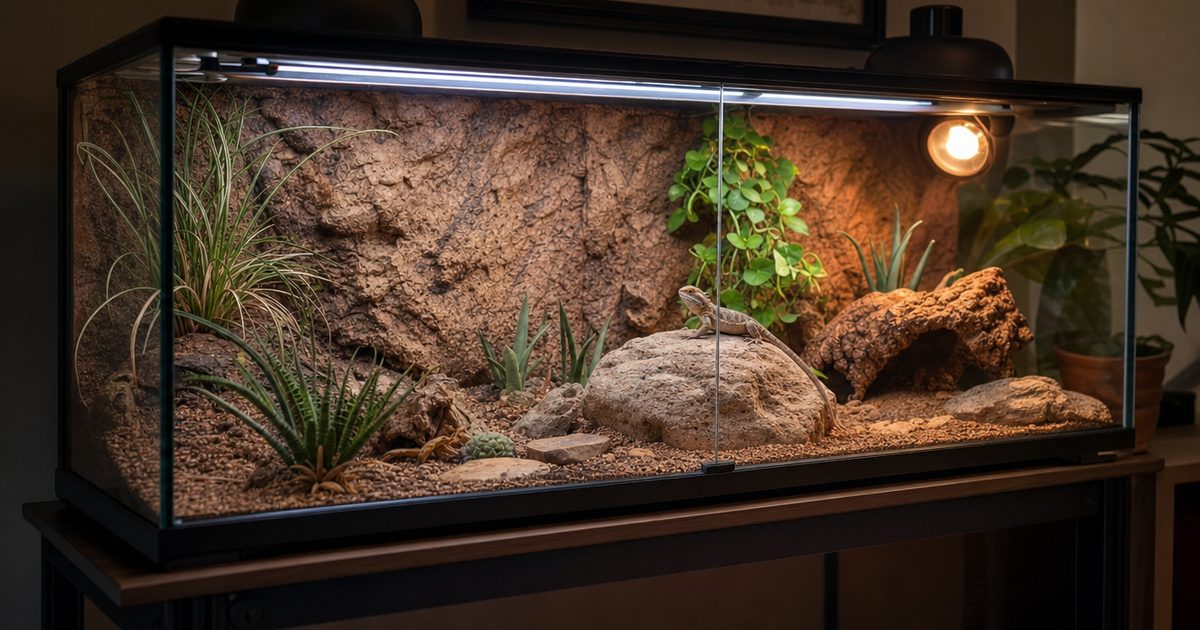
A good first vivarium gets the animal a setup it can actually live well in from day one. The difference between a thriving reptile and a stressed, off-colour one is almost never the price of the gear — it is getting three things right before anything else: the enclosure footprint, a real heat gradient on a thermostat, and the correct UVB index at the correct distance. This guide walks the setup in the order it matters, so you build the environment once, properly: husbandry first, décor later.
A quick word on how I write here. I'm Dana, the founder of Heat & Hide, and I've kept reptiles as a hobbyist for more than twelve years out of Tucson, Arizona — currently a leopard gecko, a crested gecko and a ball python, and I've set up enclosures for friends' bearded dragons too. My first setup was a mistake I'd rather you skip. The opinions here come from years of real keeping; the product numbers and parameters come from manufacturer documentation and reputable herpetological references, not from any lab test I'm pretending to have run. I keep those two things separate, always — and none of this is veterinary advice.
Why the environment comes before the décor
The most common way a first vivarium goes wrong is getting the order backwards: people buy the enclosure for how it looks, drop in some plants and a pretty background, then bolt the heat and light on as an afterthought. But a reptile is ectothermic — it can't make its own body heat, so it relies entirely on its environment to warm up, cool down, digest and stay healthy. That makes the temperature gradient, the UVB and the humidity the things its body actually runs on. A beautiful enclosure built on a wrong gradient still leaves you with a stressed, hidden, off-colour animal.
So the rule on this site is husbandry first, décor later. Get the environment right — the footprint, the gradient on a thermostat, the correct UVB at the correct distance, the right humidity — and then make it look good once the parameters check out. Décor that helps the animal feel secure (cover, hides, sight-lines) is part of good husbandry; décor that only looks nice to you is the last thing you add, never the first.
My first setup got the gradient wrong
I'll tell you the mistake honestly, because it's the reason this site exists. My first leopard gecko went into a small tank set up exactly the way the pet-store starter kit said: a stick-on dial thermometer on the glass, an under-tank heat mat with no thermostat, and a coil UVB bulb dropped in because the box said "reptile light." The dial read fine — but it was reading the glass, not the floor where the gecko actually was. The mat ran unregulated, so the warm end swung too hot while the cool end was useless. There was no real gradient at all.
Within a few weeks the gecko went off its food, stayed hidden, and looked stressed and pale. I didn't understand why until a more experienced keeper at a local reptile meet-up put a digital probe on the substrate and showed me the actual numbers. They explained the thing I'd missed completely: a real temperature gradient on a thermostat, the correct UVB index at the correct distance, and proper hides are non-negotiable. I switched to a thermostat-controlled heat source, a digital probe thermometer, a proper UVB tube and warm, cool and humid hides — and the gecko recovered and came back to feeding. It was a close call, not a tragedy, and I got lucky. Heat & Hide exists so no other beginner has to learn it the hard way at the animal's expense.
The first fundamental: a real heat gradient on a thermostat
A gradient is simply a warm end and a cool end in the same enclosure, so the animal can move between them to control its own body temperature — that's thermoregulation, and it's the whole point of reptile heating. A single warm spot is not a gradient. The species-specific numbers (the basking temperature, the cool-end temperature, the night-time drop) come from manufacturer documentation and reputable herpetological references, and they vary a lot: a desert basker like a bearded dragon wants a high, focused basking zone, while a ground-dwelling species like a leopard gecko needs gentler belly heat and a clear cool retreat.
Whatever heat source you use, the rule that protects the animal is the same: run it through a thermostat. An unregulated mat, ceramic heat emitter or panel can swing far too hot, and there is no safe gradient without one. A thermostat holds the warm end in range so the animal always has a safe place to be. The other half of the job is measuring it: a digital probe thermometer placed at the substrate, where the animal actually sits, tells you the truth a stick-on dial on the glass never will. The reptile heating and thermostats hub walks through basking lamps, ceramic heat emitters, heat panels and mats, and on/off versus dimming thermostats in full.
The second fundamental: the correct UVB index at the correct distance
UVB is the part beginners get wrong most often, and for many species it's the one the animal can least afford wrong. UVB lets a reptile produce vitamin D and use calcium properly, and how much it needs is set by the species: a desert basker like a bearded dragon needs a high UV index, while a shade-dwelling leopard gecko needs far less. Two numbers decide whether the animal actually gets what it needs — the index (how strong the UVB is) and the mounting height or distance (how far the tube sits from where the animal basks). Both come straight off the manufacturer's charts for the specific tube.
This is exactly where my first setup failed: a coil bulb produces a small, intense spot rather than spreading the right index across the basking area, and many coil and compact bulbs are considered inadequate for high-UVB species. The widely preferred choice is a linear T5 HO tube of the correct index, mounted at the distance the manufacturer specifies. One more thing nobody warned me about: UVB output fades long before the tube stops making visible light, so it has to be replaced on the manufacturer's schedule — commonly every 6 to 12 months for many T5 HO tubes — not when it finally dies. Treat every UVB number as general husbandry guidance and verify it for your species.
Enclosure types in plain English
The enclosure is the foundation everything else mounts to, and it's the decision people overthink most. There are really two questions: what it's made of, and which way it's oriented.
Glass terrarium vs PVC vivarium
A glass terrarium is cheaper and easy to find, but loses heat and humidity through the panels, so it can be harder to hold a stable gradient in a cool or dry room. A PVC vivarium holds heat and humidity far better and gives solid, secure sides that a shy species often prefers, at a higher price. Neither is "right" — the choice depends on your room conditions, your species' humidity needs and your budget. The reptile enclosures hub compares them side by side on the specs that decide the fit.
Terrestrial vs arboreal
Terrestrial (ground-dwelling) species — ball pythons, bearded dragons, leopard geckos — need floor space and don't use much height. Arboreal (climbing) species — crested geckos, many tree-dwelling snakes — need vertical space with branches and elevated cover. Matching the enclosure shape to how the species lives is half the battle; a tall enclosure wastes space for a ground-dweller, and a long, low one gives a climber nowhere to go. The other half is size: bigger is generally better, as long as you can still hold a genuine warm end and cool end. The classic beginner instinct — "small and warm is cosy" — gets it backwards; a bigger enclosure that holds a real gradient beats a small, uniformly warm box every time.
By species: ball python vs bearded dragon
The same three fundamentals apply to every reptile, but the numbers change with the species. Here's how the two most common beginner animals differ, framed in plain terms — always verify the current parameters for your specific animal and morph.
Ball python — the terrestrial snake
A ball python is a ground-dwelling snake that wants floor space, not height, a warm gradient on a thermostat, snug hides on both the warm and cool ends, and humidity it can actually maintain — which is where a humid hide and the right substrate earn their place. UVB requirements for ball pythons are lower than a desert basker's, but low-level UVB is increasingly considered beneficial; check current guidance for your snake. A shy, secure snake is a healthy one, so secure sides and good hides matter more here than in many setups. The best ball python enclosures and best ball python substrates guides go deeper.
Bearded dragon — the desert basker
A bearded dragon is a desert species with the opposite lighting needs: a high UV index and a hot, focused basking zone, plus the floor space of a terrestrial animal. This is the species where getting the UVB light and the basking bulb right matters most — a beardie under weak or wrongly mounted UVB is the textbook husbandry failure. Humidity stays low, the gradient runs hot at the basking end and cool at the other, and the enclosure needs to be big enough to hold both.
The full beginner cart, in buying order
The enclosure is the first purchase, not the only one. Buy in this order and you build the environment from the ground up instead of bolting it on — this is the natural beginner cart-stack, and each link below opens the guide for that piece.
- The enclosure — sized to your species, oriented for how it lives, big enough to hold a warm end and a cool end. Get this right first. See the reptile enclosures hub.
- The heat source + thermostat — a basking lamp, ceramic heat emitter or panel, always on a thermostat, building a real gradient you verify with a digital probe. See the heating and thermostats hub.
- The UVB tube + fixture — the correct index for your species, in a T5 HO fixture, mounted at the manufacturer's distance, replaced on schedule. See the UVB and lighting hub.
- Substrate + hides — a substrate suited to the species' humidity needs, plus at least a warm hide and a cool hide, and a humid hide where the species needs one. See the habitat and monitoring hub.
- Thermometer + hygrometer — a digital probe thermometer at the substrate and a hygrometer where the animal spends time, so you measure the gradient and humidity instead of guessing.
- Water + feeding — last, set up to the species' requirements once the environment is dialled in.
The rookie mistakes to skip
Almost all first-setup regret comes from the same short list. Avoid these and you're ahead of where I was with my first stressed gecko.
- A stick-on dial thermometer and no thermostat. The dial reads the glass, not the animal, and an unregulated heat source has no safe gradient. A stick-on dial ruins more first setups than a cheap bulb does. Use a digital probe at the substrate and a thermostat.
- A coil or compact UVB bulb of the wrong index. A small, intense spot instead of the right index across the basking area — often inadequate for high-UVB species. Use a T5 HO tube of the correct index at the correct distance.
- Buying "small and warm" to keep it cosy. A small box can't hold a gradient. Size for a genuine warm end and cool end, oriented for how the species lives.
- Décor before husbandry. Plants and backgrounds on top of a wrong gradient still leave a stressed animal. Get the environment right, then make it look good.
- Forgetting the UVB replacement cycle. Output fades before the tube dies. Replace it on the manufacturer's schedule, not when it stops lighting up.
Frequently asked questions
What do I need to set up a reptile vivarium?
The core kit is an enclosure sized to your species, a heat source on a thermostat to build a real temperature gradient, the correct UVB index at the correct mounting height, substrate and at least a warm and a cool hide, and a digital thermometer and hygrometer to monitor it. Treat published parameters as general husbandry ranges and verify for your species.
What are the three things that must be right?
Enclosure footprint sized to the species, a real heat gradient controlled by a thermostat, and the correct UVB index at the correct distance. Get those three right and the rest is detail; get them wrong and the animal cannot thermoregulate or stay healthy. This is general husbandry guidance, not veterinary advice.
Why does the environment come before the décor?
A reptile’s health depends on its temperature gradient, UVB and humidity far more than on how the enclosure looks. Beautiful décor on top of a wrong gradient still leaves a stressed animal. Husbandry first, décor later — build the environment the animal needs, then make it look good.
Do I really need a thermostat?
Yes. An unregulated heat source can swing too hot and there is no safe gradient. A thermostat keeps the warm end in range so the animal can choose its temperature. A real temperature gradient on a thermostat is non-negotiable husbandry — see the heating guides for how to set one up.
How big should a beginner reptile enclosure be?
Big enough to hold a genuine warm end and a cool end, sized to your species — a terrestrial species like a ball python or bearded dragon needs floor space, an arboreal species like a crested gecko needs height. Bigger is generally better as long as you can still hold the gradient. Verify the current minimum for your species and size.
Why is a coil or compact UVB bulb a common mistake?
Coil and compact UVB bulbs produce a small, intense spot of UVB rather than spreading the right index across the basking area, and many are considered inadequate for high-UVB species. A linear T5 HO tube of the correct index, mounted at the manufacturer’s distance, is the widely preferred choice. Match the index and fixture to your species and verify it.
Where to go next
The four silos, each starting from a beginner-first hub, plus the setup tools.
Keeping reptiles often runs alongside other backyard and home animal-keeping. If you also keep a flock, our sister site on raising backyard chickens shares the same welfare-first, get-the-setup-right approach to coops and care.