Best UVB Lights for Bearded Dragons
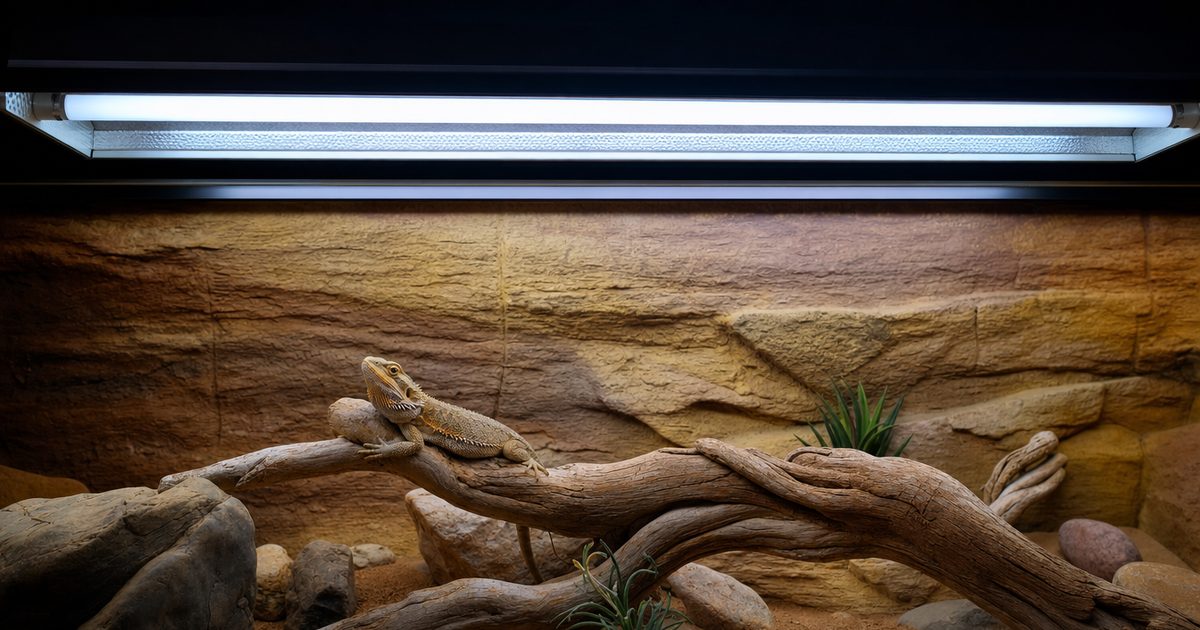
UVB is the spec beginners get wrong most often, and it is the one a desert species like a bearded dragon can least afford to have wrong. The right tube delivers the correct UV index at the basking spot, at the correct mounting height. This guide compares UVB lights on the specs that decide the fit: type, UVI, tube length, coverage and fixture.
Verified picks land in each slot once real product data is in. For now, this is the framework: what each spec changes, so you can shortlist a tube that delivers the right index for your enclosure and species.
Specs verified against manufacturer details and current Amazon listings — no hands-on testing claims. UV index figures and mounting heights are general husbandry parameters sourced to manufacturer documentation and reputable herpetological references; always verify for your species. This is general husbandry information, not veterinary advice.
How to choose a UVB light for a bearded dragon
UVB is the spec beginners get wrong most often, and a bearded dragon is the worst species to get it wrong on. As a high-UVB desert animal, a beardie depends on a strong, correctly-mounted UVB source to support its biology in captivity, where natural sunlight is not part of the picture. The goal is not "a reptile light" — it is the correct UV index reaching the basking spot at the correct distance, from a tube that actually spreads UVB across the area the dragon uses.
Four specifications decide whether a UVB light does that job: the type (a linear T5 HO tube versus a compact or coil bulb), the strength or UVI the lamp produces, the tube length and coverage relative to your enclosure, and the fixture and mounting height that place the lamp at the right distance. Every figure here — the index, the distance, the replacement interval — comes from the manufacturer's published charts and reputable herpetological references, not from guesswork, and every one is a parameter to verify for your animal rather than a personal measurement.
Type: T5 HO tube vs compact and coil UVB
Type is the first and most consequential UVB spec. The two broad options are a linear T5 HO (high-output) fluorescent tube and a compact or coil bulb that screws into a standard socket. They are not close substitutes.
A T5 HO tube is a long, linear lamp that spans much of the enclosure and casts UVB across a wide band, so the dragon receives UVB wherever it sits in the basking zone rather than only in one small spot. Spec-by-spec, a T5 HO tube reaches the strength a high-UVB desert species needs and distributes it over a usable area, which is why it is the standard recommendation for bearded dragons. A compact or coil bulb, by contrast, produces a small, concentrated point of UVB from a screw-in fixture. Spec-by-spec, that concentrated point is widely considered inadequate for a high-UVB desert species: the output is narrow, the index drops off sharply away from the bulb, and the dragon cannot easily position itself in the right zone. The persona's own origin mistake was exactly this — a coil bulb dropped in because the box said "reptile light." For a bearded dragon, the type decision is effectively made: a linear T5 HO tube is the spec to shop for.
UVI and lamp strength
UVI — the UV index — is the actual measure of UVB intensity reaching the animal, and it is the number the whole setup is built around. Different species sit in different "Ferguson zones" of UV exposure, and a bearded dragon, as a full-sun desert basker, sits near the top, needing a relatively high index at its basking spot. Spec-by-spec, a tube's percentage rating (for example a higher-percentage T5 HO) tells you how much UVB it produces, but the index the dragon actually receives depends on that output combined with the mounting distance.
This is the key subtlety: you do not buy a UVI, you produce one. The manufacturer publishes a chart pairing each tube with the distance that yields a given index. You read the target index for your species, find the distance on the chart that delivers it for that specific tube, and mount the lamp there. A meshed top reduces the UVB that passes through, so the chart distance assumes whether the lamp sits over or under the mesh. Treat the index and the chart figures as general husbandry parameters sourced to the manufacturer, and verify them for your dragon — ideally with a UV index meter if you have access to one.
Tube length and coverage
Length and coverage decide how much of the enclosure actually receives UVB. A tube that spans a good fraction of the enclosure length casts UVB across the basking area and into the zone the dragon moves through, so the animal can choose its exposure. Spec-by-spec, a tube that is too short for the enclosure leaves UVB "dead zones" where the dragon gets little or none, defeating the purpose. Match the tube length to the enclosure: a longer enclosure wants a longer tube, generally positioned over the warm, basking end where the dragon spends its bright-light hours. The aim is overlap between where the heat is, where the bright light is, and where the UVB is — so the basking site delivers all three at once, the way the sun does.
Fixture and mounting height
The fixture is what turns a tube into a working UVB source at the right distance. A T5 HO tube needs a matched T5 HO fixture (a reflector-equipped housing rated for that tube); a reflector meaningfully increases the usable UVB directed down into the enclosure. Mounting height is the spec that ties everything together: it is the distance in the manufacturer's chart that sets the index the dragon receives. Mount too high and the index falls short; mount too low and it can run stronger than intended. Spec-by-spec, the fixture and its mounting height are how you convert a tube's rated output into the correct UVI at the basking spot — which is why "what tube" and "at what height" are really one question, answered together off the chart.
The replacement cycle
UVB output is not permanent. A fluorescent UVB tube keeps producing visible light long after its UVB output has faded below a useful level, so a tube that looks fine can be delivering far less UVB than it did when new. Spec-by-spec, that is why UVB tubes are replaced on a schedule rather than when they stop lighting — commonly every 6 to 12 months for many T5 HO tubes, per the manufacturer's stated interval. Mark the install date, follow the manufacturer's replacement schedule, and if you own a UV index meter, verify the output rather than relying on the calendar alone. A tube past its replacement interval is one of the quiet ways a setup that "looks right" stops doing its job.
UVB is the lighting layer — close out the habitat
Getting UVB right completes the lighting half of the setup, alongside the heat. With the enclosure, the heat gradient and the UVB sorted, the last layer is the habitat — the substrate, hides and humidity the animal lives on. See the guide to the best substrates and bedding for how the floor of the enclosure controls humidity, and run the UVB and heat and enclosure matcher to check the index, mounting height, wattage band and footprint your species needs in one place. To compare T5 HO against compact UVB across species, the UVB and lighting hub lays out the index-by-species picture.
The UVB lights compared
| Best for | Type | UVI | Tube-length | Coverage | Fixture |
|---|---|---|---|---|---|
| Best overall | T5 HO linear UVB (5.0) + hood | Moderate (5.0 / desert) | 14" | Small-to-mid enclosure | Included hood/fixture |
| Best budget | T5 HO linear UVB (5.0) bulbs | Moderate (5.0) | Linear T5 HO | Standard enclosure | Bulbs only (fixture not included) |
| Best T5 HO kit | T5 HO linear UVB + reflector fixture | High output (desert/12%) | Linear T5 HO | Full enclosure length | Pro reflector fixture included |
| Best for tall enclosures | T5 HO linear UVB (10.0) | High (10.0 / desert) | 22" | Tall / deep enclosures | Bulb (fixture compatible) |
| Best compact option | Compact fluorescent UVB (5.0) | Moderate (5.0) | Mini compact (coil) | Small / spot coverage | E26 socket (dome fixture) |
Our top picks
Best overall: Zoo Med ReptiSun 5.0 T5-HO 14" Terrarium Hood with UVB Bulb

Best overall
Zoo Med ReptiSun 5.0 T5-HO 14" Terrarium Hood with UVB Bulb
Zoo Med
- Type: T5 HO linear UVB (5.0) + hood
- UVI: Moderate (5.0 / desert)
- Tube-length: 14"
- Coverage: Small-to-mid enclosure
- Fixture: Included hood/fixture
This Zoo Med kit pairs a ReptiSun 5.0 T5 HO UVB tube with a matching hood, giving keepers a complete, proven UVB solution out of the box. It is the best overall pick for bearded dragons needing reliable linear UVB plus a fixture.
Last checked 2026-06-15
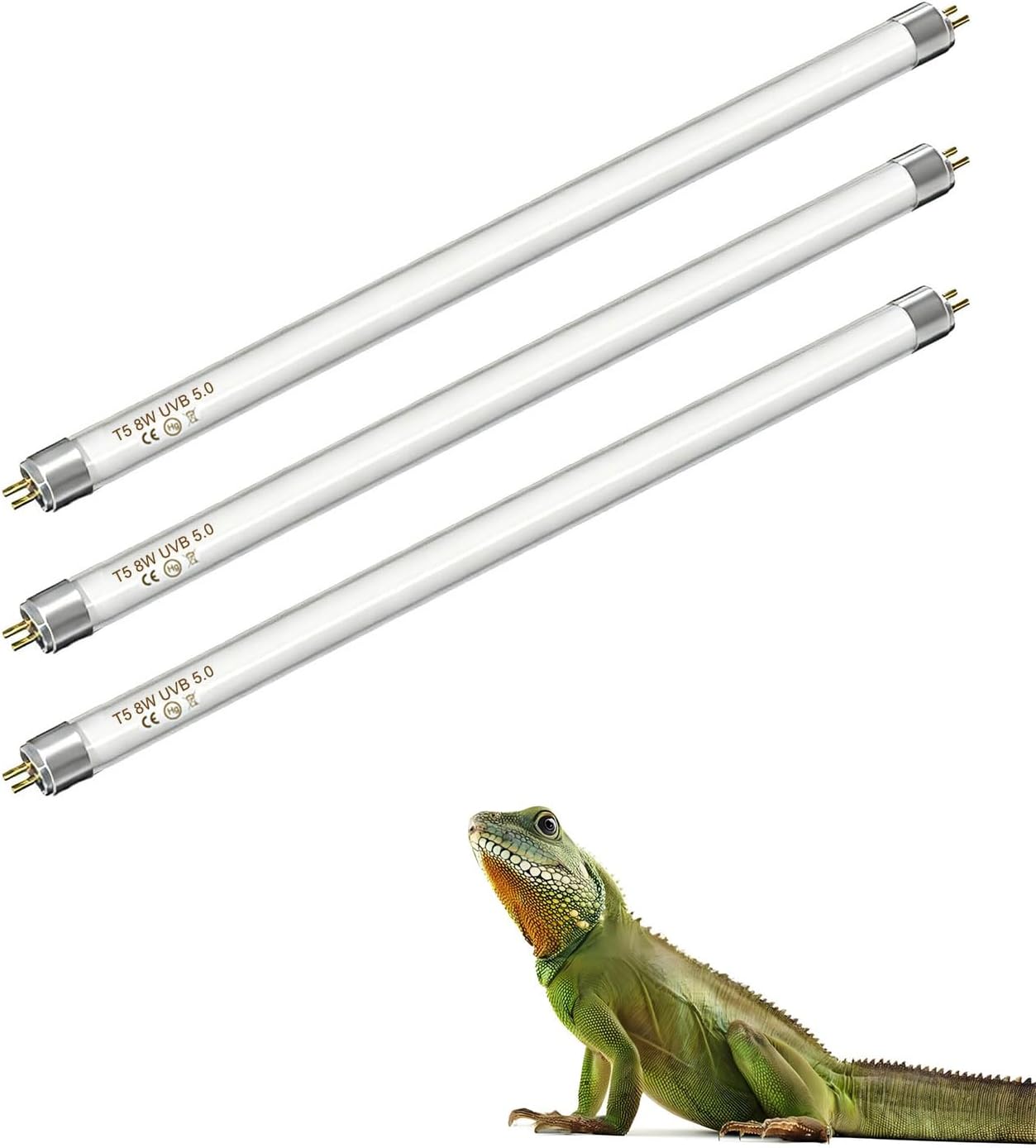
Best budget: MouMouPurr 3 Pack T5 HO 5.0 UVB Reptile Light Bulbs
Best budget
MouMouPurr 3 Pack T5 HO 5.0 UVB Reptile Light Bulbs
MouMouPurr
- Type: T5 HO linear UVB (5.0) bulbs
- UVI: Moderate (5.0)
- Tube-length: Linear T5 HO
- Coverage: Standard enclosure
- Fixture: Bulbs only (fixture not included)
This 3-pack of T5 HO 5.0 UVB tubes gives keepers low-cost replacement bulbs to keep UVB output fresh. It suits budget keepers who already own a T5 HO fixture and want spare tubes for scheduled replacement.
Last checked 2026-06-15
Best T5 HO kit: Arcadia Pro T5 UVB Lighting Kit for Reptiles (Fixture + High Output T5 Tube)

Best T5 HO kit
Arcadia Pro T5 UVB Lighting Kit for Reptiles (Fixture + High Output T5 Tube)
Arcadia
- Type: T5 HO linear UVB + reflector fixture
- UVI: High output (desert/12%)
- Tube-length: Linear T5 HO
- Coverage: Full enclosure length
- Fixture: Pro reflector fixture included
The Arcadia Pro T5 kit combines a high-output T5 tube with an efficient reflector fixture for strong, even UVB across the enclosure. It is the best premium T5 HO kit for keepers wanting top UVB performance and a quality reflector.
Last checked 2026-06-15
Best for tall enclosures: Celiwace T5 10.0 UVB Reptile Light Bulb 22 inch, Desert High Output UVB

Best for tall enclosures
Celiwace T5 10.0 UVB Reptile Light Bulb 22 inch, Desert High Output UVB
Celiwace
- Type: T5 HO linear UVB (10.0)
- UVI: High (10.0 / desert)
- Tube-length: 22"
- Coverage: Tall / deep enclosures
- Fixture: Bulb (fixture compatible)
This 10.0 desert-strength T5 HO tube pushes more UVB to reach animals basking farther from the lamp, important in tall enclosures. It suits keepers with deep or tall bearded-dragon setups where 5.0 output would be too weak at distance.
Last checked 2026-06-15
Best compact option: Zoo Med ReptiSun 5.0 Mini Compact Fluorescent UVB Lamp 13 Watts

Best compact option
Zoo Med ReptiSun 5.0 Mini Compact Fluorescent UVB Lamp 13 Watts
Zoo Med
- Type: Compact fluorescent UVB (5.0)
- UVI: Moderate (5.0)
- Tube-length: Mini compact (coil)
- Coverage: Small / spot coverage
- Fixture: E26 socket (dome fixture)
The ReptiSun 5.0 Mini Compact screws into a standard dome for UVB in small enclosures or where a linear tube won't fit. It is the best compact pick for nano or travel setups, though linear T5 HO is preferred for full-size bearded-dragon enclosures.
Last checked 2026-06-15
Frequently asked questions
What UVB strength does a bearded dragon need?
A bearded dragon is a desert species with a high UVB requirement, so it needs a strong (high-percentage) T5 HO tube at the correct mounting height to deliver the right UV index at the basking spot. The exact index and distance come from the manufacturer’s charts. Treat these as general husbandry parameters and verify for your dragon.
T5 HO tube or compact UVB for a bearded dragon?
A linear T5 HO tube is the standard choice — it spreads UVB across the basking area and reaches the index a beardie needs. Compact and coil bulbs produce a small, intense spot and are widely considered inadequate for a high-UVB desert species. This guide compares them on the specs that matter.
How often do I replace a UVB tube?
UVB output fades long before the tube stops producing visible light, so the tube must be replaced on the manufacturer’s schedule (commonly every 6 to 12 months for many T5 HO tubes) rather than waiting for it to die. Follow the manufacturer’s replacement interval and verify with a UV meter if you have one.
How high should a bearded dragon UVB light be mounted?
The right mounting height is the distance on the manufacturer’s chart that delivers the target UV index for your species with that specific tube — not a fixed number, because output and distance work together. Mesh between the lamp and the basking spot also reduces UVB, so factor that in. Read the chart for your exact tube and verify the index for your dragon, ideally with a UV meter.
Will a UVB light heat the basking spot?
No. A UVB tube provides ultraviolet output, not significant basking heat, so it does not replace the basking bulb. A bearded dragon needs both — a separate heat source for the basking temperature and a UVB tube for the index — usually arranged so the heat, the bright light and the UVB overlap over the basking site.
Is a screw-in coil or compact UVB bulb okay for a bearded dragon?
For a high-UVB desert species like a bearded dragon, compact and coil bulbs are widely considered inadequate because they produce a small, concentrated point of UVB rather than spreading a usable index across the basking area. A linear T5 HO tube in a matched fixture is the standard choice. Verify the index and distance from the manufacturer’s chart for your setup.