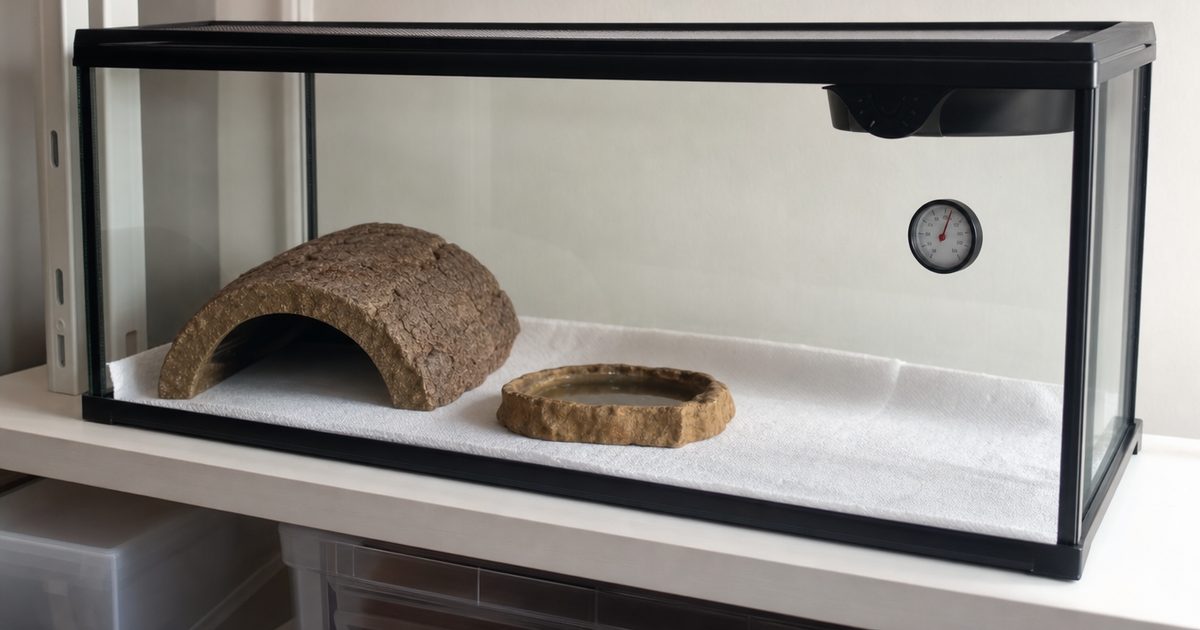
Bringing home a new reptile is the fun part, and it’s exactly where I make myself slow down. The first few weeks are when a new animal is most stressed, most likely to be carrying something you can’t see, and least forgiving of a setup that’s hard to monitor. So I don’t put a new arrival straight into a lush, planted display. I set up a simple quarantine, watch it closely, and earn my way to the beautiful enclosure later.
To be clear up front: I’m a keeper, not a vet. Quarantine here is about giving a new animal a calm, observable settling-in period and not exposing existing animals — not about diagnosing or treating anything. Health questions go to a reptile vet, full stop.
Why a plain setup beats a pretty one at first
A naturalistic bioactive build is gorgeous and great for an established animal. For a brand-new one, it works against you, because you can’t see what’s going on. Is it eating? Are its droppings normal? Is it shedding cleanly? Are there any mites? In a planted enclosure with deep substrate and lots of cover, all of that is hidden. In a simple setup, it’s obvious at a glance.
So for quarantine I deliberately go plain:
- Simple, easy-to-clean substrate — often something like paper towel or a plain liner — so I can see droppings clearly and swap it out completely without disturbing a whole ecosystem.
- A couple of basic hides — warm end and cool end — because security still matters even in a plain setup, and a stressed new animal needs somewhere to feel safe.
- A clean water dish and the minimum furniture needed for the animal to feel secure and behave normally.
It’s not about deprivation. It’s about visibility. Once the animal is settled, feeding, and clearly healthy over a sensible window, then it graduates to the planted enclosure.
The parameters still have to be right
Quarantine being simple doesn’t mean cutting corners on the environment. The new enclosure still needs the same non-negotiables as any other: a real thermal gradient on a thermostat, the correct UVB at the correct distance if the species needs it, and the right humidity range for the species, confirmed with a probe thermometer and a hygrometer. A new arrival is already stressed — a wrong gradient or a dried-out enclosure on top of that is the last thing it needs. Get the husbandry right; just keep the décor minimal and watchable.
What I’m actually watching for
Across the settling-in window I’m looking for the boring signs that things are going well: it comes out and explores, it takes food and keeps it down, its droppings look normal, it sheds in one piece, and there’s no sign of mites or laboured breathing. None of that is me diagnosing — it’s me observing whether a new animal is settling, and knowing that anything that looks off is a cue to call a reptile vet rather than guess.
Don’t skip it because you’ve got one animal
People assume quarantine is only for multi-animal collections, and the protect-your-other-animals reason is real — but it’s not the only one. Even with a single pet, the quarantine period is the close-observation window that catches problems early, while the setup is simple enough to actually see them. It’s worth doing for the watchability alone.
After quarantine
Once an animal has settled and is clearly doing well, the upgrade to a full naturalistic enclosure — substrate, hides, plants, the works — is the reward, and the place where the habitat layer really gets to shine. The habitat & monitoring hub covers that layer: substrate, the warm/cool/humid hides, and the thermometers and hygrometers that prove your gradient and humidity are actually where you think they are.
This is general husbandry information from my own keeping experience, not veterinary advice. Quarantine practices and species requirements vary — always verify for your animal, and if a new arrival is off its food, losing condition, or behaving abnormally, see a qualified reptile vet rather than waiting it out.