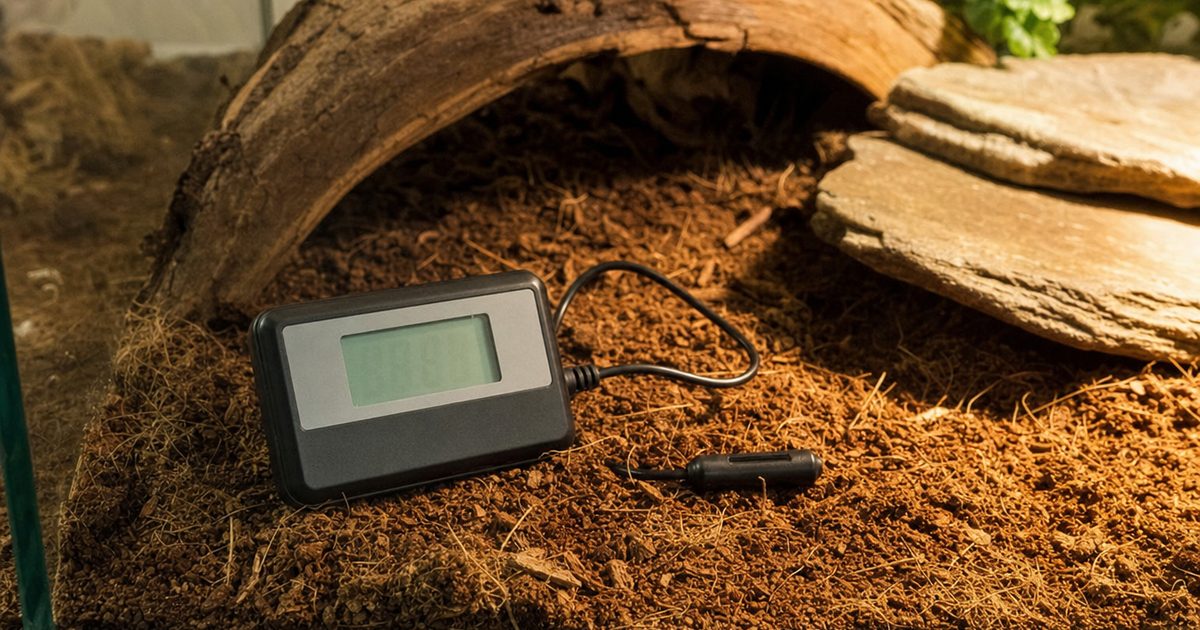
The single cheapest mistake in my first setup, and the one that did the most damage, was the stick-on dial thermometer. It cost almost nothing, came with the kit, and told me a comforting number that was measuring the wrong thing entirely. A keeper at a meet-up put a digital probe on the floor of my enclosure, showed me the real number, and that one swap changed how I keep reptiles. So here’s the honest case for how I read my enclosures now — and why the dial went in the bin.
What a stick-on dial actually measures
A stick-on dial thermometer sticks to the glass. So it reads the temperature of a pane of glass, usually up the side of the enclosure, an inch or more off the substrate. Your animal does not live on the glass. It lives on the floor, on the basking surface, in the hide. The dial is answering a question you didn’t ask, and answering it with a slow, often inaccurate analogue gauge on top of that.
In my first setup the dial read fine while the floor my gecko was lying on was a different temperature, and the warm end was overshooting because nothing was regulating the heat. The number reassured me right up until my animal went off its food. A measurement of the wrong surface is worse than no measurement, because it’s confidence without information.
Why I use digital probes
A digital probe thermometer puts the sensor on the exact surface you care about — the substrate at the warm end, the basking spot, the cool end — and reads it directly. That’s the whole upgrade: I get to choose what gets measured, and I measure where the animal actually is.
What I run now:
- A probe at the warm end, on the floor or basking surface, so I know the temperature the animal experiences at the hot end.
- A check at the cool end to confirm there’s a genuine gradient — that the cool end is actually cool, not just slightly-less-warm.
- A hygrometer — ideally a digital probe one — for humidity, because for a lot of species humidity is as important as temperature and the cheap dial hygrometers drift badly.
The probe thermometer also pairs with the thermostat without replacing it. The thermostat controls the heat; the independent probe verifies what’s actually happening. I don’t let one device both control and report, because that’s exactly where a blind spot hides.
What “reading the numbers” actually means
Having probes is step one; reading them well is step two. A few habits from years of keeping:
- Measure the surface, not the air. Air temperature is a weak proxy. The basking surface and the floor are what the animal’s body touches.
- Check both ends, not just the warm one. A correct warm end means nothing if there’s no cool end to retreat to. The gradient is the point.
- Let it settle before you trust it. A reading taken right after you change something isn’t proven. I tune, wait, and recheck.
- Watch the trend, not one reading. Any single reading has a bit of noise. A number drifting over several days is the real signal — that’s when the room’s changed season, or the UVB’s aging, or the substrate’s dried out.
The numbers are sourced, the probe just confirms them
Worth being clear: the target ranges I’m reading against — basking temperatures, cool-end temperatures, humidity ranges — come from reputable herpetological references and manufacturer guidance, given as ranges, and I verify them for the exact species. I don’t invent targets and I’m not bench-measuring gear. The probe’s job isn’t to argue with the published range; it’s to tell me whether my actual enclosure matches it. Sourced target, measured reality, check they line up.
The cheapest upgrade you can make
If you do one thing after reading this, replace the stick-on dial with a digital probe and put the probe where the animal actually sits. It’s a small spend that turns a comforting fiction into real information, and it’s the change that would have saved my first gecko a stressful few weeks.
The monitoring gear — thermometers, hygrometers, and how to place them so they’re reading the right surface — lives in the habitat & monitoring hub alongside the substrate and hides that hold those numbers steady. Read the floor, not the glass, and verify the parameters for your species.
This is general husbandry information from my own keeping experience, not veterinary advice. Target temperatures and humidity ranges vary by species and morph and come from manufacturer documentation and herpetological references — always verify for your animal, and see a qualified reptile vet for any health concern.