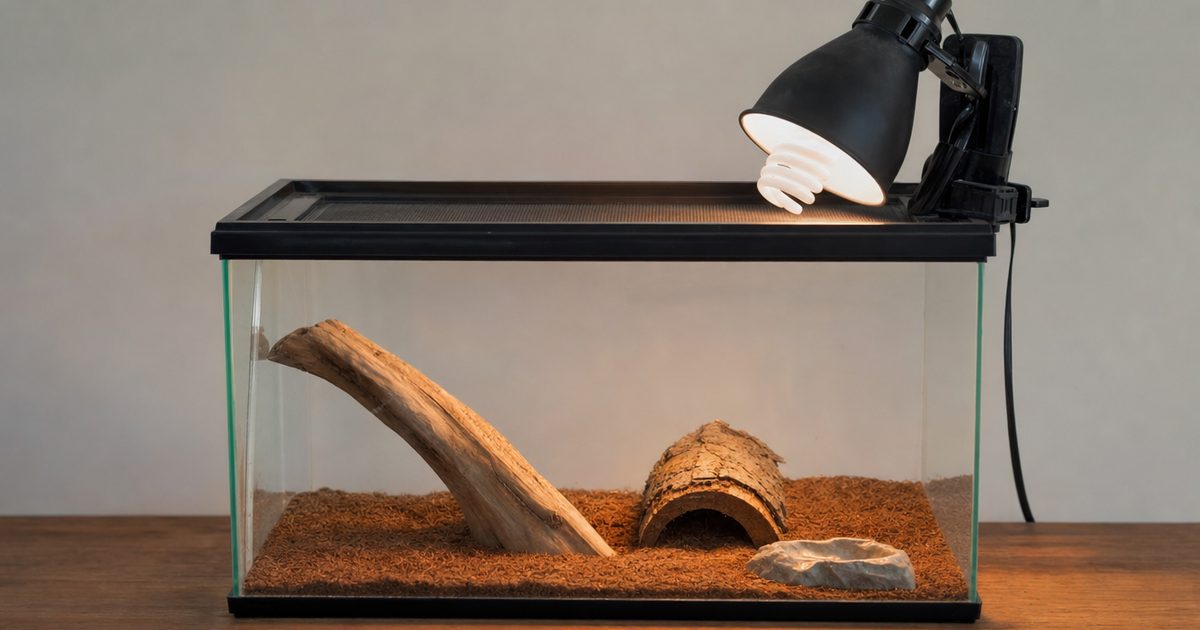
The all-in-one reptile starter kit is how a huge number of beginners — me included — get into the hobby, and I understand the appeal completely. One box, one price, everything you “need,” and a picture on the front of a happy animal. The trouble is that my first setup came out of exactly that kind of kit, and it’s the reason my first gecko nearly didn’t make it. So this is the honest breakdown of the cheap-kit trap: what these kits genuinely get right, what they quietly leave out, and where the real money actually has to go.
What the kits get right
I don’t want to be unfair. A starter kit usually gets you a few real things: an enclosure of some size, a lamp fixture, a couple of basic hides, a water dish, maybe a bag of substrate. As a box of bits, it’s not all junk, and the enclosure and fixtures can be perfectly usable.
The problem isn’t usually that the parts are fake. It’s that the most important parts are missing, downgraded, or wrong — and they’re missing precisely because they’re the parts a beginner doesn’t yet know to ask for.
What they quietly leave out
Here’s what my kit left out or got wrong, and it’s a remarkably consistent list across cheap kits:
- No thermostat. This is the big one. The kit gives you a heat source and nothing to regulate it, so it runs unregulated straight off the wall. The single most important safety device in the whole setup is the one thing the kit doesn’t include — because adding it would push the price up and the box is competing on price.
- A stick-on dial thermometer instead of a probe. The kit’s idea of “monitoring” is a dial that sticks to the glass and reads the glass, not the floor where the animal sits. It gives you a reassuring, meaningless number.
- A coil/compact UVB instead of the right tube at the right distance. “Reptile light” on the box does not mean the correct UVB strength mounted at the correct distance. A coil dropped in is not the same job.
- An enclosure that’s on the small side. Small enough that it can’t hold a real warm-to-cool gradient, which is the thing the whole setup exists to provide.
Each of those gaps is invisible to a beginner. You assemble the kit, it looks complete, the dial reads fine — and you have no idea the gradient is wrong and nothing’s regulating the heat. That’s the trap: it doesn’t look like a corner was cut.
Where the money actually goes
The reframe that would have saved me: the enclosure and the bulb are not where the money matters most. The money that matters goes on the invisible gear that makes the visible gear safe and correct:
- a thermostat to regulate the heat source,
- a digital probe thermometer (and a hygrometer) to read the floor and the humidity, not the glass,
- the correct UVB tube for the species at the correct mounting distance,
- an enclosure with enough footprint to hold a gradient,
- and proper hides — warm, cool, and humid.
None of those photograph as exciting on a box front, which is exactly why kits skimp on them. But they’re the difference between a setup that looks right and one that is right.
”Buy once” beats “buy cheap then buy again”
The cruel maths of the cheap kit is that you usually end up buying the missing pieces anyway — a thermostat, a probe, a proper UVB — after something goes wrong, so you pay for the kit plus the real gear plus the stress of a stressed animal in between. Working out what the species actually needs first, and buying that, is cheaper and kinder than the kit-then-fix path I took.
Do the homework before the box
I’m not anti-starter-kit on principle — a good enclosure and fixtures can come from one. I’m against buying a kit instead of understanding what your species needs. Read the requirements, list the gear that meets them, and then see how much of that list a kit honestly covers — usually not the thermostat, the probe, or the right UVB.
I wrote the whole beginner setup out in the order I’d actually buy it now, including the boring-but-essential gear the kits skip, in the guide on how to set up a reptile vivarium. Build the list around the animal’s needs, not around what fits in one box.
This is general husbandry information from my own keeping experience, not veterinary advice. Gear requirements vary by species and morph — always verify what your animal needs, and see a qualified reptile vet for any health concern.