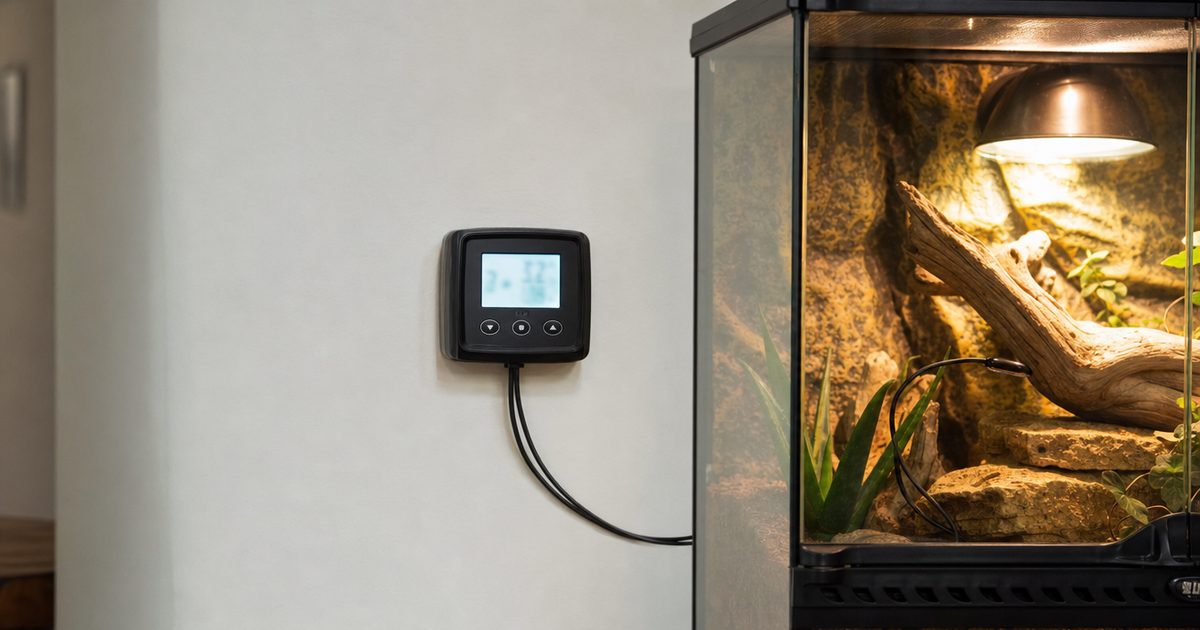
If a new keeper asks me what the single most important piece of gear is, I don’t say the enclosure, the bulb, or the UVB. I say the thermostat. Not because it’s exciting — it’s the most boring box in the whole setup — but because it’s the one piece that decides whether your heat source is a controlled environment or an unregulated risk. After years of keeping, I treat a thermostat as a safety device, not an upgrade.
What “no thermostat” actually means
A heat source plugged straight into the wall has exactly one setting: on. A heat mat runs at full output continuously. A basking bulb pours out its full wattage the entire time it’s on. Nothing is watching the temperature and nothing is throttling the heat back when the warm end has reached where it should be.
That was my first setup. A heat mat, no thermostat, and a stick-on dial that read the glass instead of the floor. The warm end climbed higher than I realised while I sat there reassured by a number that wasn’t measuring the right thing. The animal paid for it with a stressed, off-colour few weeks before another keeper put a probe on the floor and showed me what was actually happening.
A thermostat closes that gap. It reads the temperature with a probe and cuts or dials the heat source back when the target is reached, then lets it warm again when it drifts down. That’s the entire job — and it’s the job that keeps a warm end from quietly overshooting while you’re not looking.
Why room temperature isn’t enough to save you
A common beginner thought is “my house is a stable temperature, so the heat source will be stable too.” It doesn’t work like that. Room temperature drifts — warmer afternoons, colder nights, a radiator kicking on, a window left open. An unregulated heat source adds the same heat regardless, so a warm end that’s fine on a cool morning can run too hot on a warm afternoon. The thermostat is what holds the warm end steady while the room around it moves.
On/off versus dimming — the honest version
There are two broad types and beginners get understandably confused, so here’s how I think about it:
- On/off thermostats switch the heat source fully on or fully off around your target. They’re simple, affordable, and fine for non-light heat sources like heat mats and ceramic heat emitters, where flicking on and off doesn’t bother anything.
- Dimming (pulse-proportional) thermostats ramp the power up and down smoothly instead of hard-switching. These are what you want for a visible basking bulb, because hard on/off switching of a light bulb means it’s flicking on and off all day, which is both annoying and harder on the bulb.
The short rule I use: mat or ceramic emitter, an on/off thermostat does the job; a basking light bulb, use a dimming one so it isn’t strobing. Either way, something is regulating the heat. That’s the non-negotiable part.
Put the probe where the animal is
A thermostat is only as good as where its probe sits. Mounted up in the air or stuck to the glass, it’s regulating to a temperature your animal never experiences. I place the thermostat probe at the level the animal actually basks or rests — on the basking surface, or on the floor at the warm end — so the number it’s controlling to is the number that matters. And I keep a separate digital probe thermometer to confirm the floor temperature independently, because trusting one device to both control and report is how blind spots creep in.
The mistake I see most often
The thing I watch beginners do over and over is spend on the visible stuff — the nice enclosure, the décor, a fancy bulb — and treat the thermostat as the optional extra to add “later.” Later is exactly when the warm end has already overshot. The thermostat isn’t the part you add once the setup is pretty. It’s the part that makes the heat safe to run at all.
If you want the heating side laid out properly — basking lamps versus ceramic emitters versus mats, on/off versus dimming, and how it all builds into a real gradient — the reptile heating & thermostats hub ties it together. Pick the heat source your species needs, then never run it without something regulating it.
This is general husbandry information from my own keeping experience, not veterinary advice. Target temperatures and the right heat source vary by species and morph — always verify the requirements for your animal, and if it’s unwell or behaving abnormally, see a qualified reptile vet.