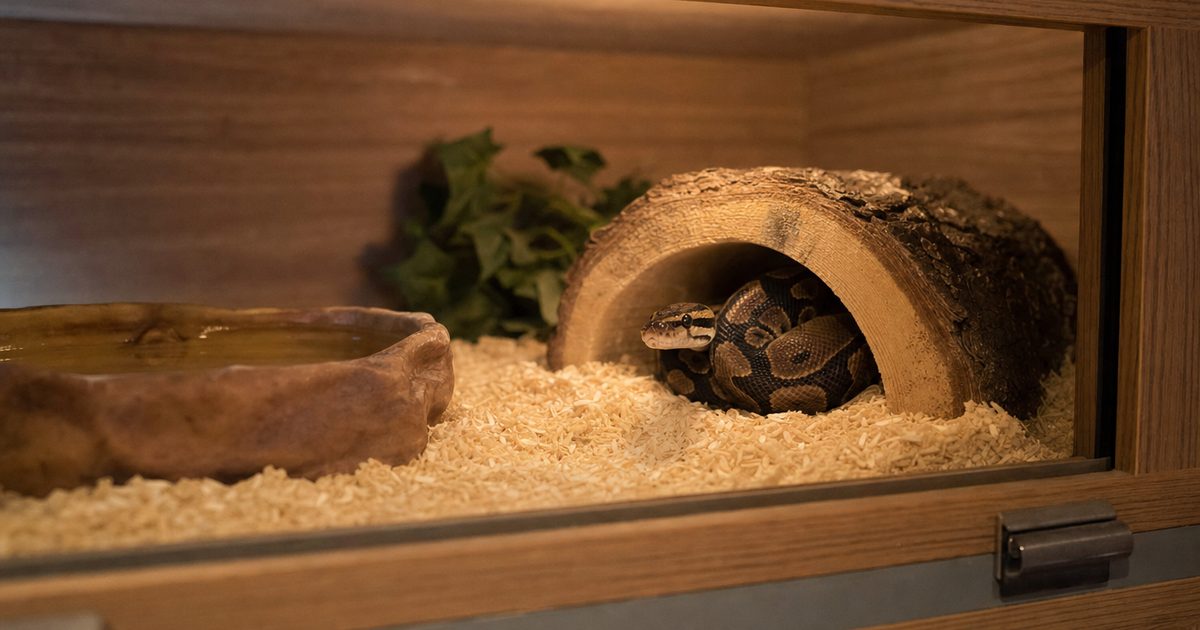
Ask ten keepers what size enclosure a ball python needs and you’ll get a genuinely heated argument, which is funny for an animal famous for sitting still. I keep a ball python, and I’ve changed my own mind over the years, so here’s the honest version — not the dogma from either camp, but how I actually think about it now.
The myth that confuses everyone
The old line is “ball pythons like it tight, so keep them in a small space or they’ll stress.” There’s a grain of truth buried in it: ball pythons are a secretive, hide-loving species, and a wide-open space with nowhere to tuck away does stress them. But the conclusion people draw — therefore keep them cramped — is the wrong fix for the right observation.
The animal isn’t asking for a small enclosure. It’s asking for a secure one. Those are different problems with different solutions. You solve “I feel exposed” with good hides and clutter, not by shrinking the whole world down to a shoebox.
Footprint versus security
Here’s how I separate the two:
- Footprint is the floor space — length and width. This is what lets you build a real thermal gradient: a warm end and a genuinely cool end the snake can move between. A footprint that’s too small can’t hold a gradient, so the snake can’t thermoregulate properly, and that’s a husbandry failure no amount of “they like it tight” excuses.
- Security is whether the snake feels safe within that footprint. You provide it with snug hides at both the warm and cool ends, plus cover and clutter — plants, branches, leaf litter — so it can cross the enclosure without feeling exposed.
When you give a ball python a proper footprint and proper security, you get the best of both: room for a real gradient, and a snake that feels safe enough to use all of it. A cramped tub gives you neither a gradient nor, ironically, real security — just a small box.
The “tub” question
Plenty of people keep ball pythons in tubs in a rack, and I’m not here to pick a fight about that — it can be done with attention to heat and humidity. But for a single pet ball python in a home, I keep mine in a front-opening enclosure with a footprint that holds a gradient and enough furnishing that it’s never short of a hide. That’s a personal keeping choice, not a measured test, but it’s the setup I’ve been happiest with and the one I’d point a beginner toward.
Why bigger-with-a-gradient wins
The argument I make to anyone agonising over size: a slightly larger enclosure that holds a real warm-to-cool gradient and is well furnished with hides beats a small one every time, because it lets the animal do the two things it actually needs — thermoregulate and feel secure. The fear that “a big space stresses them” is really a fear of an empty space. Fill it correctly and the size stops being the problem.
The other half of size is humidity, which ball pythons care about and which interacts with enclosure type — a more open glass tank holds humidity differently than a sealed front-opening enclosure. That’s its own topic, but it’s worth knowing that “what size” and “what kind” are linked questions, not separate ones.
Glass versus PVC, briefly
Since size and enclosure type go together: glass terrariums are cheap and visible but vent heat and humidity through their mesh tops, while PVC vivariums hold heat and humidity far better and are usually front-opening, which most snakes find less stressful than a lid lifting off above them. For a ball python specifically, the humidity-holding side often nudges keepers toward PVC — but a well-managed glass setup can work too.
The honest bottom line
Don’t keep a ball python cramped because someone said they like it tight. Give it a footprint that holds a real gradient, then make that footprint feel secure with snug hides and clutter at both ends. Size and security are two problems; solve both.
If you want that turned into concrete options — footprints, glass versus PVC, and what actually suits a ball python — the best ball python enclosures guide lays it out, with the figures sourced rather than guessed.
This is general husbandry information from my own keeping experience, not veterinary advice. Enclosure minimums, temperatures and humidity vary by species and morph — always verify for your animal, and see a qualified reptile vet for any health concern.