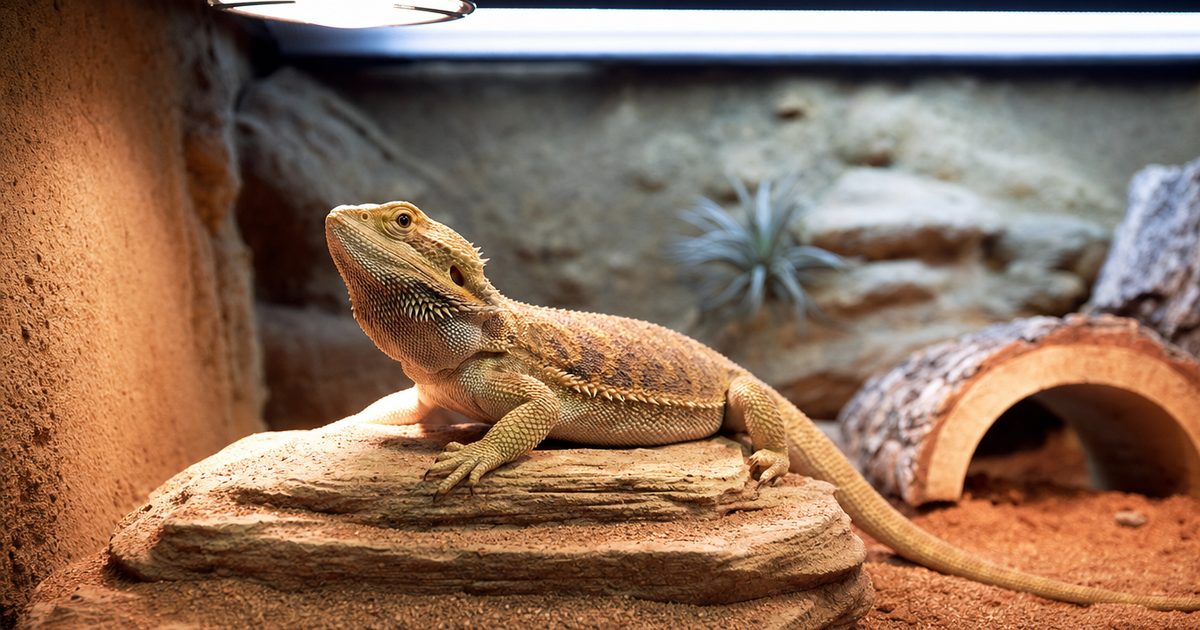
I don’t keep a bearded dragon myself, but I’ve set up enclosures for a few friends’ beardies, and the basking spot is reliably the part that gets done wrong first. A bearded dragon is a hard-basking desert lizard — it wants a properly hot basking spot to power its day — and that’s both the thing beginners under-deliver on and, occasionally, the thing they overshoot dangerously. So here’s how I approach a beardie basking setup, the husbandry-first way.
Why beardies are different from a gecko
A leopard gecko and a bearded dragon want almost opposite things, and that trips people up because the word “reptile” makes them sound like one care sheet. A leopard gecko is a crepuscular ground-dweller that takes most of its warmth from below and doesn’t bask hard. A bearded dragon is a sun-worshipping desert agama that climbs onto a rock and bakes. So a beardie’s basking spot needs an overhead heat source delivering a genuinely hot spot, plus strong UVB, plus a real gradient to retreat into. You can’t just scale up a gecko setup.
The basking spot itself
Here’s the chain I work through:
- Overhead heat, not under-tank. Beardies bask from above, so the heat comes from an overhead basking bulb aimed at a basking surface — a rock or branch the animal can climb onto and get close to. An under-tank mat doesn’t recreate desert sun.
- A basking surface at a sensible height. The animal needs to get up toward the heat, so I give it something to climb onto and then set the bulb height so the basking surface lands in the right temperature range. Height is a real control here — raising or lowering the bulb changes the basking temperature as much as swapping wattage does.
- The right wattage for the enclosure. Wattage that’s fine in a big enclosure can cook a small one, and wattage that warms a small one won’t reach the basking surface in a tall one. So wattage is matched to the enclosure size and the gap to the basking spot, not picked off a generic chart.
- On a thermostat — always. A basking bulb on a dimming thermostat holds the basking spot at target instead of climbing on a warm afternoon. This is where beardies get hurt: a hot desert basking target plus no regulation plus a warm room is exactly how a basking spot overshoots.
Measure the surface, not the air
The number that matters is the temperature on the basking surface, where the animal’s body actually sits — not the air temperature, and definitely not a dial stuck to the glass. I put a probe on the basking rock and tune the bulb height and the thermostat until that surface reads in the sourced range, then leave it to settle and recheck. A basking spot that reads right for five minutes hasn’t proven it holds.
Don’t forget the cool end
A hot basking spot is only safe because the animal can leave it. The beardie bakes to temperature, then walks down the gradient to a genuinely cool end to shed that heat. If the whole enclosure is hot — too small a footprint, or heat in the middle — the animal can’t get away from the basking heat, and a correct basking temperature becomes a trap. Big footprint, heat at one end, real cool retreat.
UVB sits alongside the heat
Beardies need strong UVB as well as strong heat, and the two are separate jobs — the basking bulb gives heat, the UVB tube gives UV. People sometimes assume one bulb does both; it doesn’t, reliably. I run a proper UVB tube at the manufacturer’s distance to the basking spot, matched to the species. That’s its own topic, but worth flagging so the basking spot isn’t the only thing you sort.
Where the targets come from
Every basking and cool-end figure I work to comes from reputable herpetological references and manufacturer guidance, given as ranges, and I verify for the specific animal. I don’t bench-measure bulbs or invent numbers — I match published targets to the species and confirm the surface with a probe.
If you want the wattage bands and how to pair a basking bulb with a thermostat spelled out, the best basking bulbs for bearded dragons guide is the place — sourced figures, no hands-on testing claims.
This is general husbandry information from my own keeping experience, not veterinary advice. Basking temperatures, UVB and enclosure sizing vary by species and morph — always verify for your animal, and see a qualified reptile vet for any health concern.