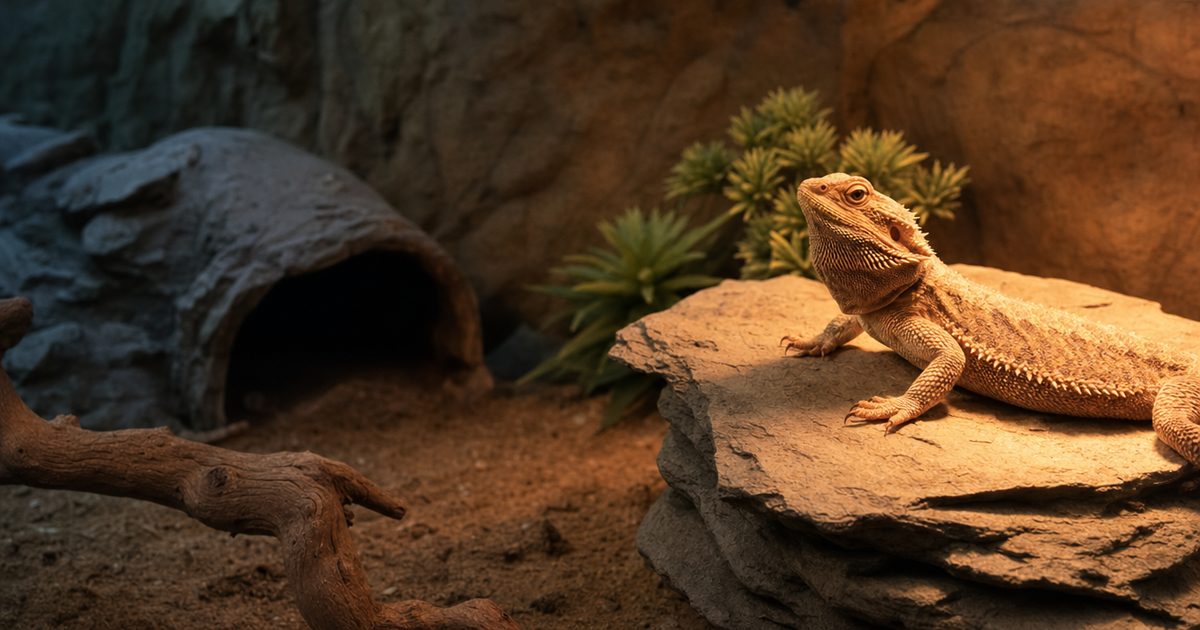
A heated tank and a thermal gradient are not the same thing, and the difference is the whole point of getting reptile heating right. My first setup was a “warm tank” — heat going in, a number on a dial — and it nearly cost my gecko, because a reptile doesn’t need warmth, it needs choice. It thermoregulates by moving between a warm end and a cool end. If both ends are the same, there’s nowhere to move to, and a warm tank with no cool retreat is just as wrong as one that’s too cold.
So here’s how I actually build and tune a gradient now, after years of keeping. It’s not complicated. It just has to be measured rather than assumed.
Why “choice” is the design goal
A reptile in the wild moves into the sun to warm up and into shade or a burrow to cool down. In an enclosure you’re recreating that as a spread across the floor: a warm end where it can bask up to its target, and a genuinely cool end where it can shed that heat. The animal does the regulating — your job is to make sure both ends exist and both sit in the right range.
That’s also why enclosure size and heating are linked. A small tank can’t hold a real gradient, because the heat from one end bleeds across the whole floor and the “cool” end never gets cool. Bigger-with-a-gradient genuinely beats small-and-warm.
How I build and tune it
This is the routine I follow every time I set up or reset an enclosure.
- Heat at one end, never the middle. I mount the basking lamp or heat source over one end so the temperature naturally falls off toward the far end. Heat in the centre gives you a warm middle and two lukewarm ends — the opposite of what you want.
- Heat source on a thermostat. The heat source runs through a thermostat with its probe at the basking surface, so the warm end is held to a target rather than climbing unregulated. This is the non-negotiable I never skip.
- Measure the floor at both ends. I put a digital probe thermometer on the substrate at the warm end, then move it to the cool end. Crucially I read the floor where the animal actually sits — not a dial on the glass, which reads the glass, not the animal.
- Confirm a real spread. I check that the cool end is genuinely cooler than the warm end. If both ends read about the same, the enclosure is too small or running too hot overall, and I fix that before the animal goes in.
- Tune to the published range. I adjust the thermostat target and the basking height until the warm end and cool end land within the sourced range for the species, then leave it to settle for a while and recheck — a setup that reads right for ten minutes isn’t proven yet.
Where the numbers come from
I don’t invent the targets. Basking temperatures and cool-end ranges come from reputable herpetological references and the gear manufacturers’ guidance, and they differ a lot by species — a desert basker like a bearded dragon wants a hot basking spot a leopard gecko would never use. I match the published range to the species and verify for the exact animal and morph. The point of the probe isn’t to argue with those numbers; it’s to confirm the actual floor matches them.
The mistakes that flatten a gradient
A few things I watch beginners do that quietly kill the gradient:
- Heat in the middle, so there’s no cool end.
- An enclosure too small to hold a spread, so it’s warm corner to corner.
- Reading the glass with a stick-on dial instead of the floor with a probe, so the “good” number is measuring the wrong surface.
- No thermostat, so the warm end overshoots whenever the room warms up.
Fix those four and you usually have a real gradient.
Getting the warm end right
The warm end is only as good as the basking source making it. If you’re sorting a bearded dragon’s basking spot specifically, the best basking bulbs for bearded dragons guide covers the wattage bands and how to pair them with a thermostat — so the warm end you build hits its sourced target and holds there.
This is general husbandry information from my own keeping experience, not veterinary advice. Basking and cool-end temperatures vary by species and morph and come from manufacturer documentation and herpetological references — always verify for your animal, and see a qualified reptile vet for any health concern.