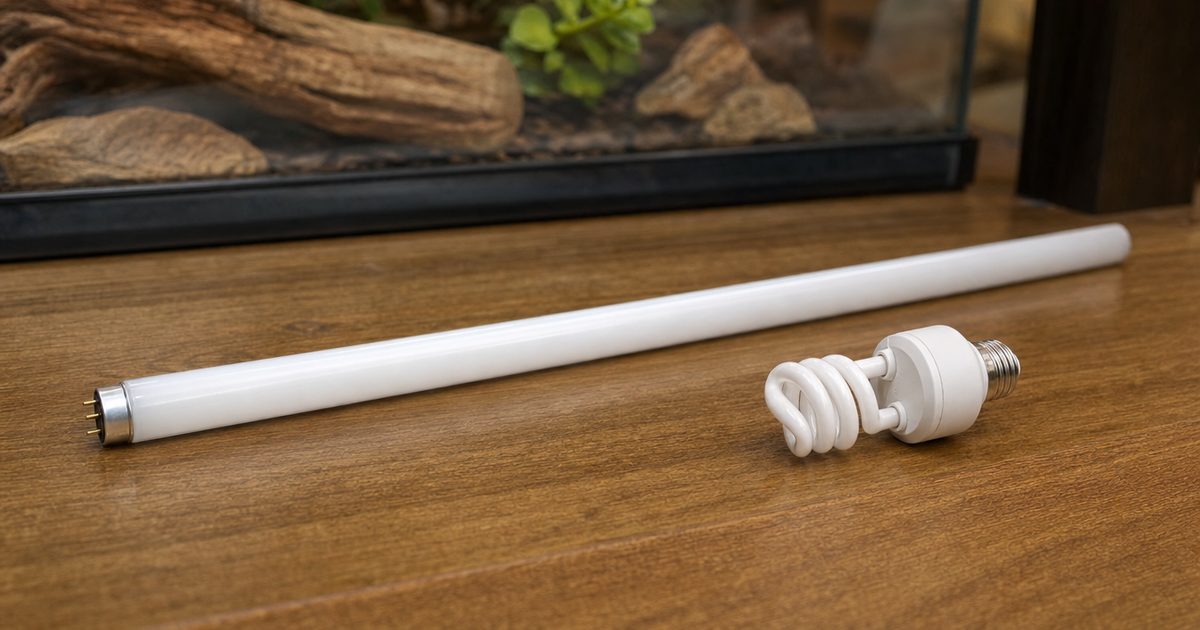
The coil UVB bulb was part of my first-setup mistake, and swapping it for a proper T5 HO tube was one of the clearest before-and-afters I’ve had as a keeper. I’d dropped a compact coil into a lamp because the box said “reptile light,” assumed that ticked the UVB box, and moved on. It didn’t. Here’s the honest version of the difference, because UVB is the area where getting it wrong quietly hurts the animal, and it’s worth understanding rather than guessing.
What UVB is even for
UVB lighting lets many reptiles produce vitamin D, which they need to use calcium properly. Get it badly wrong over time and you’re heading toward serious health problems — which is exactly why I won’t diagnose or promise anything here. What I can talk about is gear: the type of UVB source, its strength, and where it sits relative to the animal.
There are two things that matter, and beginners usually only think about the first:
- The bulb — coil/compact versus a linear T5 HO tube, and its UVB strength.
- The distance — how far the animal basks from the UVB source.
You can buy the right tube and still get it wrong on distance. That’s the part I want to hammer.
Coil vs T5 HO — the real difference
A coil (compact) UVB bulb is a small, screw-in, folded fluorescent. A T5 HO is a long linear tube in a reflector fixture that spans much of the enclosure.
In my own keeping, the difference came down to coverage and reach:
- A coil throws UVB from a single small point. That means a narrow zone of useful output and a steep fall-off — and historically, compact bulbs are the ones people associate with the most variability. It’s a small source trying to do a big job.
- A T5 HO tube spreads UVB across a long line, so the animal gets a usable gradient of UV across the basking area rather than one hot pinpoint. With a good reflector, the useful output reaches a workable basking distance instead of dying inches from the bulb.
When I switched, the practical change was that I finally had a UVB zone the animal could sit in and move through, the same way it moves through the heat gradient — instead of a tiny spot directly under a coil that may or may not have been doing much by the time it reached the basking surface.
Why distance is the part people miss
UVB drops off fast with distance, and it drops off differently depending on the bulb’s strength and whether there’s mesh in between. So “I bought a strong tube” doesn’t finish the job — a strong tube mounted too far away can deliver too little at the basking spot, and a strong tube mounted too close can deliver too much.
The way I handle it: I match the tube strength to the species and then mount it at the distance the manufacturer specifies for that strength, measured to where the animal actually basks — not to the floor, not to the top of the glass. Mesh between the tube and the animal cuts UVB too, so that’s part of the distance picture, not an afterthought. The pairing of strength-and-distance is the whole game. Either one alone tells you nothing.
This is also where I lean on sourced numbers rather than vibes. UVB index targets and mounting distances come from the bulb manufacturer’s documentation and reputable herpetological references, given as ranges for a species group — desert species that bask hard want more than a shade-dwelling tropical gecko. I don’t invent these and I don’t bench-measure them; I match the published guidance to the animal and verify for the exact species.
Replacement — the quiet one
One more thing I wish I’d known earlier: UVB output fades before the bulb stops lighting up. A tube can look perfectly fine to your eye while its UVB has dropped well below useful. So UVB bulbs are on a replacement schedule, not a “replace it when it dies” basis. I note the install date and replace on the manufacturer’s cycle rather than waiting for the light to fail, because by the time it visibly fails, the UVB has been inadequate for a while.
What I’d tell my beginner self
Don’t drop a coil in and call UVB done. Match a T5 HO tube’s strength to your species, mount it at the manufacturer’s distance to the basking spot, account for any mesh, and replace it on schedule. If you want that turned into specifics for the most common beardie setups, the best UVB lights for bearded dragons guide lays out the strengths and mounting distances, all sourced rather than guessed.
This is general husbandry information from my own keeping experience, not veterinary advice. UVB strength, index targets and mounting distances vary by species and morph and come from manufacturer documentation and herpetological references — always verify for your animal, and see a qualified reptile vet for any health concern.